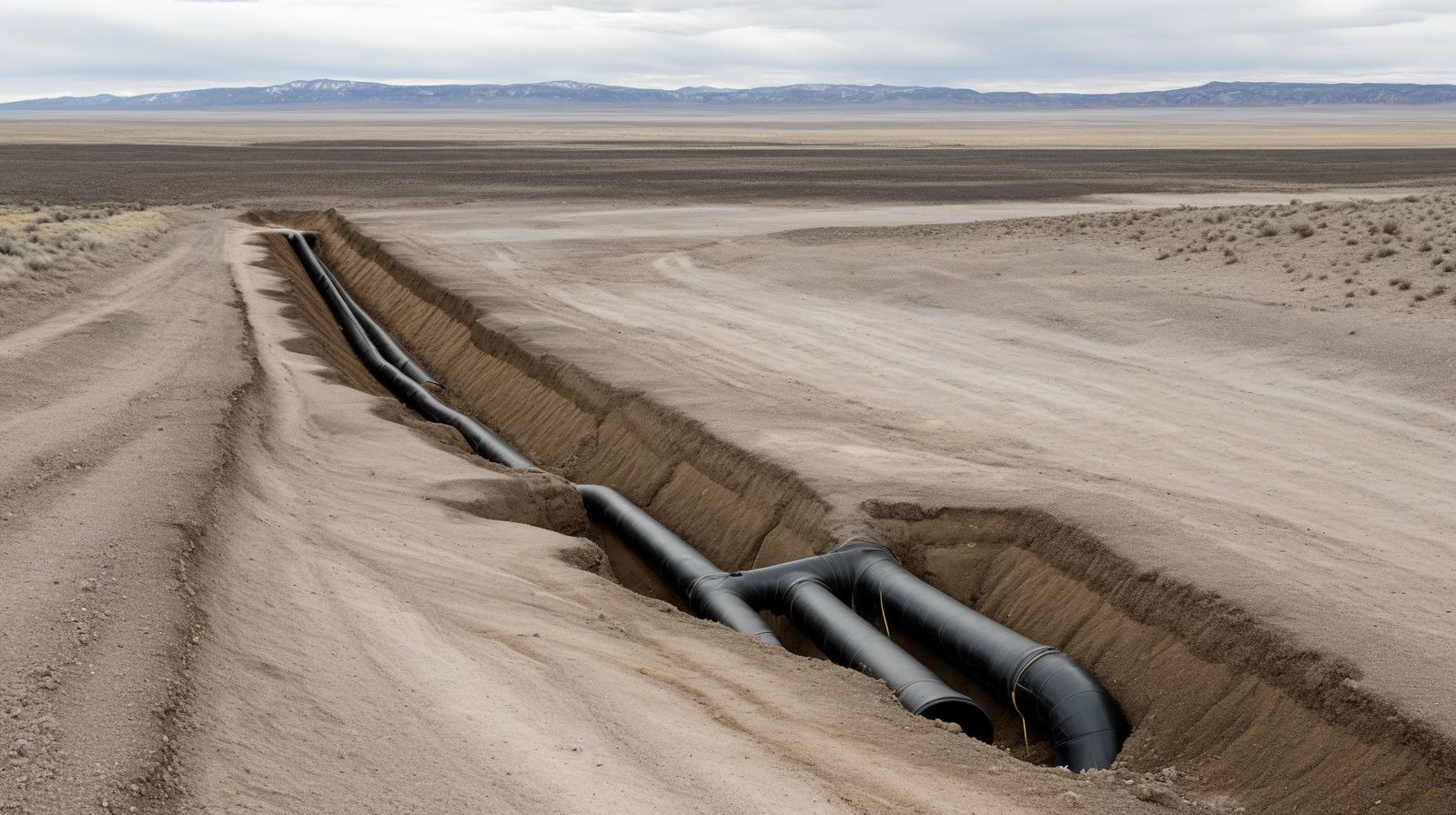
Something's wrong between your well and your house — let's find it
A line problem can look like a pump problem, a pressure problem, or nothing obvious at all until you get a water bill or notice a soggy patch of ground. We locate leaks, repair breaks, and replace failing lines across seven counties in southern Colorado. We don't drill wells, so every recommendation we make is based on what your line actually needs.
- National Ground Water Association
- Colorado Water Well Contractors Association
- Bonded & insured
- Free estimates and project quotes
What you're noticing
These symptoms usually trace back to the line, not the pump
Pressure problems and pump behavior are easy to blame on the pump itself, but the line between your well and your building is often where the trouble starts.
What's included
Work we do on water lines
Everything from the well casing to the point where the line enters your building — diagnosis, repair, or full replacement.
-
Leak location
We use pressure testing and, where the line is inaccessible, electronic leak detection to find exactly where water is escaping before any digging starts. Pinpointing the leak first keeps excavation targeted and cost down. See our dedicated leak location page for detail on how that process works.
-
Line repair
When a line has a single break or a localized failure, a targeted repair is usually the right call and costs a fraction of a full replacement. We excavate to the problem, cut out the damaged section, and restore the line to full working pressure.
-
Line replacement
Older polybutylene or galvanized lines that are failing in multiple places don't reward repeated repairs. We replace the full run with modern polyethylene pipe rated for the pressure and ground conditions on your property.
-
Line depth and burial correction
Colorado code requires lines to be buried below the frost line — and in our elevation range, shallow burial is the single most common reason lines freeze and burst. We excavate and re-lay lines that were installed too close to the surface.
-
Frozen and burst line repair
When a freeze has already happened, the damage needs to be assessed before the ground thaws further. We locate the burst section, repair or replace it, and check whether depth was the root cause so it doesn't repeat.
-
Excavation for access
We own our own excavation equipment, so there's no separate contractor to coordinate when digging is part of the job. That keeps the diagnostic and repair work in one crew and one schedule.
We work the supply side — well to building envelope only. Interior plumbing, fixtures, water heaters, drains, and well drilling are outside our scope; if you need any of those, we'll tell you directly and point you the right direction.
Cheapest first
How we work through a line problem before spending your money
We start with the least expensive thing that could explain what you're seeing and confirm or rule it out before moving to the next step. Here's the sequence.
-
Pressure test at the wellhead
Before assuming the line is the problem, we test pressure at the source. If pressure is normal there and drops at the house, the line is the likely culprit. This check costs almost nothing and immediately narrows the field.
-
Visual inspection along the line route
A walk of the line route looking for wet ground, soil heave, or vegetation that's greener than the surroundings often reveals a leak location without any equipment. It's the cheapest diagnostic step and occasionally all that's needed.
-
Pressure isolation test
We can isolate sections of the line and test each one independently to confirm which segment has lost integrity. This is still a low-cost diagnostic step — no excavation, no equipment beyond a gauge and fittings.
-
Electronic leak location
When the leak isn't visible from the surface, we use acoustic or electronic detection to pinpoint it before digging. This step costs more than a visual check but far less than excavating the whole line looking for the problem.
-
Targeted repair
Once we know exactly where the failure is, a single-point repair is usually the right fix. It's the lowest-cost resolution when the rest of the line is in acceptable condition.
-
Full line replacement
When the line is old, has multiple problem areas, or is made of material that continues to fail, replacement is the more honest recommendation. It costs more upfront than another repair, but stops the cycle of repeated excavation and patches.
Call (719) 859-1148 and describe what you're seeing — we'll tell you honestly what it sounds like and what the next step is.
- Free estimates — we quote after we diagnose
- One year on labor and materials
- Colorado License #1447
Why the cheap answer is safe to give
We can afford to tell you it is the cheap part
Not because we are nicer than the next outfit. Because of how this business is built — and all three of these are checkable.
-
No rig to keep busy
A drilling rig is the most expensive thing a water contractor can own, and it has to stay working to pay for itself. We do not own one. A new well is not on our list of answers, because we could not drill it if we wanted to.
-
We are a dealer, not a manufacturer
Authorized dealer — that is where the five-year equipment warranty comes from. We do not build pumps and we do not carry a quota on them. A pump we talk you out of costs us nothing.
-
A wrong diagnosis comes back to us
One year on labor and materials means we are the ones who drive back out if the fix does not hold. Guessing expensive is not only dishonest here — it is expensive for us.
None of that is a claim about our character. You do not have to take our word for any of it — the license, the association memberships and the warranty terms are all verifiable, and they are the same on paper as they are on this page.
Questions we get asked
Before you call
The clearest test is checking pressure right at the wellhead. If pressure is normal there but low at the house, the line is the more likely cause. If pressure is low at the wellhead too, the pump or pressure tank is where to look first. Our well and pump service page and pressure tanks page cover those possibilities.
Usually, yes. We start with surface signs — wet ground, soft spots, unusual plant growth — and then use pressure isolation to narrow down which section of line is failing. Electronic detection handles cases where the leak isn't showing at the surface. We only dig once we know where to dig.
If it froze once and the depth wasn't corrected, yes — it almost certainly will again. Freeze-and-burst problems on the same line usually mean the burial depth was insufficient for the frost depth at your elevation. We can excavate and re-lay the affected section deeper as part of the repair.
We use high-density polyethylene (HDPE) or cross-linked polyethylene (PEX) rated for the pressure and ground conditions on the property. Both materials hold up better in the soil chemistry and freeze-thaw cycling common in southern Colorado than the older materials they're replacing.
No. Our work stops at the building envelope — where the line enters the structure. Everything inside, including fixtures, water heaters, and interior pipes, is interior plumbing and outside our license. A licensed plumber handles that side.
Colorado requires burial below the local frost depth, which varies with elevation. In much of the area we serve, that means deeper than many older properties were built. If your line has frozen before or was installed more than a few decades ago, depth is worth checking.
Yes, and we have no reason not to — we don't drill wells and don't own a rig. If the well itself is the problem, we'll say so plainly and you'll need a drilling contractor for that piece. We're not going to steer you toward work we do if the actual problem is somewhere else.
We come out, assess the system, and tell you what we think is happening and what it would take to fix it before you commit to anything. For a line problem that's easy to access and diagnose, that conversation usually gives you a clear picture. Harder-to-locate issues may need a diagnostic step before we can quote a full repair.
If your situation doesn't match anything here, call (719) 859-1148 — we answer 24 hours Monday through Saturday and can usually tell you over the phone whether you're looking at a line issue or something else. Call (719) 859-1148
Before we arrive
Four things that help us move faster
You don't need to have answers to all of these, but anything you can observe ahead of time shortens the diagnostic time on site.
- Note when the symptom started. Even a rough timeline — 'pressure's been dropping for about three weeks' — helps narrow whether this is a sudden failure or a slow degradation.
- Walk the line route if you know it. Look for wet patches, soft ground, or areas where the grass or weeds are noticeably greener. Mark anything that looks different with a flag or a rock so we can find it again.
- Know where your shutoff is. The shutoff at the wellhead or the pressure tank lets us isolate the system quickly. If you're not sure where it is, we'll find it, but knowing saves time.
- Write down any recent changes. New appliances, a hard freeze, heavy equipment that crossed the line route, or work done near the well are all worth mentioning — they're sometimes directly connected to what we find.
If you can't get to any of this before we come, that's fine — describing what you're experiencing is enough to get started.
Tell us what the water is doing.
We’ll tell you what it usually turns out to be, what it will take to confirm it, and what it costs — before we touch anything.
Call (719) 859-1148Answering 24 hours a day, Monday through Saturday
- Colorado License #1447 · bonded and insured
- One year on labor and materials, five on equipment
- Free estimates and project quotes — we quote after we diagnose
- NGWA and Colorado Water Well Contractors Association
Or have us call you back
If you are on bad signal or would rather not talk right now.