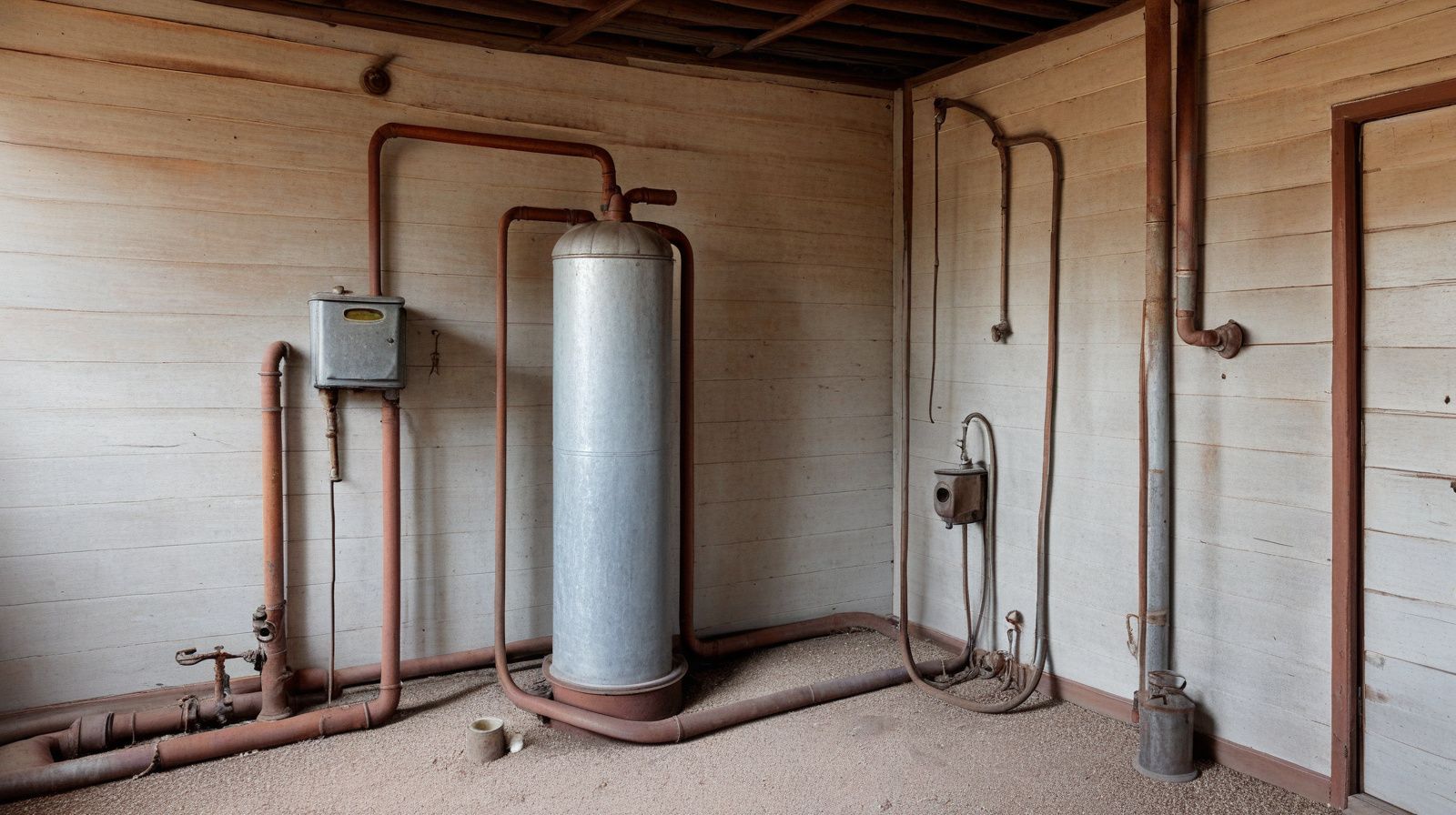
Pressure surging, pump clicking, or no water at all — it usually starts with the tank
The pressure tank is the part of your water system most likely to fail quietly before anything dramatic happens. We diagnose what's actually wrong before we recommend anything. We don't drill wells, so we have no reason to push work you don't need.
- National Ground Water Association
- Colorado Water Well Contractors Association
- Bonded & insured
- Free estimates and project quotes
What's going wrong
The symptoms are easy to recognize. The cause takes a few checks to pin down.
Most pressure problems trace back to the tank, the pump, or how the two are working together. Here's what people notice first.
What we handle
Everything from the tank itself to the controls around it
Pressure tank work usually pulls in a few related components. We handle all of them in a single visit.
-
Pressure tank diagnosis
We check air charge, bladder condition, drawdown volume, and tank sizing before recommending anything. A tank that reads failed sometimes just needs an air charge — the cheapest fix on the list.
-
Waterlogged tank — air charge service
When the bladder is still intact but the tank has lost its air pre-charge, recharging it restores normal operation without replacing the tank. This is where we start if the bladder tests good.
-
Pressure tank replacement
When the bladder has failed or the tank is undersized for your current demand, we size and install the right replacement. We carry tanks as an authorized dealer and back them with a 5-year equipment warranty.
-
Pressure switch and controls
The pressure switch tells the pump when to start and stop. A faulty switch can mimic a failing tank almost exactly. We test and replace switches as part of the same service call.
-
Constant-pressure systems
If your household demand has grown or your well struggles to keep up, a constant-pressure system uses a variable-speed drive to deliver steady pressure without oversizing the tank. We design and install these.
-
Booster pump systems
When the well delivers enough water but pressure at the building is consistently low — often on properties with elevation changes or long line runs — a booster pump is sized and added to the system.
We work supply side only, from the well to the building envelope — interior plumbing, fixtures, water heaters, and drains are outside our scope, and we do not drill wells.
Where we start
We check the cheapest fix first, every time
Pressure problems can have several causes. We work through them in order of cost so you're not paying for a repair you didn't need.
-
Check the pressure switch
A pressure switch costs very little and can cause symptoms that look exactly like a failed tank. We test it first. If it's out of calibration or failed, replacing it is the least expensive outcome on this list.
-
Test and recharge the tank's air charge
If the bladder is intact but the tank has lost its air pre-charge, we restore it with a Schrader valve and a gauge — no parts, minimal labor. This fix costs a fraction of a tank replacement and solves the problem completely when the bladder is still good.
-
Evaluate the bladder
If recharging doesn't hold, the internal bladder has failed and the tank needs to come out. We confirm this before quoting a replacement so you know exactly what you're paying for and why.
-
Size and replace the tank
Tank sizing depends on pump flow rate and household demand — not just the size of the old tank. An undersized replacement will short-cycle just like a failed one. We size it correctly the first time and back the equipment with a 5-year warranty.
-
Assess pump load and condition
A waterlogged tank that ran for months before anyone noticed often damages the pump too. Once the tank is resolved, we check pump run time and current draw to confirm the pump wasn't shortened by the stress.
-
Consider a constant-pressure or booster system if the problem is systemic
If a correctly sized tank still can't keep up with your demand, the underlying issue is flow rate or elevation, not the tank itself. That's when we talk about a constant-pressure drive or booster — the higher-cost option we only raise when the simpler fixes won't hold.
Free estimates, straight answers, and no pressure to replace something that doesn't need replacing — call (719) 859-1148.
- Free estimates — we quote after we diagnose
- One year on labor and materials
- Colorado License #1447
Why the cheap answer is safe to give
We can afford to tell you it is the cheap part
Not because we are nicer than the next outfit. Because of how this business is built — and all three of these are checkable.
-
No rig to keep busy
A drilling rig is the most expensive thing a water contractor can own, and it has to stay working to pay for itself. We do not own one. A new well is not on our list of answers, because we could not drill it if we wanted to.
-
We are a dealer, not a manufacturer
Authorized dealer — that is where the five-year equipment warranty comes from. We do not build pumps and we do not carry a quota on them. A pump we talk you out of costs us nothing.
-
A wrong diagnosis comes back to us
One year on labor and materials means we are the ones who drive back out if the fix does not hold. Guessing expensive is not only dishonest here — it is expensive for us.
None of that is a claim about our character. You do not have to take our word for any of it — the license, the association memberships and the warranty terms are all verifiable, and they are the same on paper as they are on this page.
Questions we get asked
Before you call
The quickest field test is the air valve on the top of the tank. If you press it and water comes out instead of air, the bladder has failed and the tank is waterlogged — that's your short-cycling cause. If air comes out at the right pre-charge pressure, the pump or pressure switch is more likely the culprit. We run through both checks on every call.
You can, if the bladder is still intact. Use a tire gauge to check the Schrader valve at the top of the tank with the pump off and system pressure bled down — the pre-charge should be a couple PSI below your pump's cut-in pressure. If water spurts out of the valve, the bladder is gone and adding air won't fix it. If you're not comfortable bleeding the system down first, call us — doing it with pressure on can damage the valve.
Possibly, but not necessarily. Pumps are rated for a certain number of starts per hour, and short-cycling pushes well past that limit. Once we fix the tank, we check pump current draw and run time under load. Many pumps survive a waterlogged tank if it's caught before the motor overheats. We'll tell you honestly what we find.
Tank sizing depends on your pump's flow rate in gallons per minute, your household's peak demand, and whether you have a standard or constant-pressure system. Matching the old tank's physical size is the most common mistake — undersized tanks short-cycle even when they're brand new. We calculate the drawdown volume you actually need before we order anything.
It depends on what your well can deliver. A constant-pressure drive smooths out pressure fluctuations and reduces pump wear, but it doesn't make a low-producing well produce more. If your well keeps up with demand but pressure at the tap is inconsistent, a constant-pressure system usually solves it. If the well itself is the bottleneck, the conversation goes a different direction — and we'll tell you that plainly.
We tell you. We don't own a drill rig, which means we have no financial reason to avoid that conversation. If the pressure problems trace back to the well's yield or depth rather than the tank or pump, we'll say so and refer you to a licensed driller. Sending you to the right person builds more trust than doing work that won't fix your problem.
Yes — cistern-based systems use a different setup, typically a submersible or jet pump drawing from the cistern and a separate pressure tank for delivery. We handle both the cistern side and the pressure system. See our cisterns and storage page for more on that.
Labor and materials are covered for one year. Equipment we supply as an authorized dealer carries a 5-year warranty. If something fails in that window, we come back out — that's the whole point of the warranty.
If your situation doesn't fit neatly into any of those answers, call us at (719) 859-1148 — we're there Monday through Saturday, 24 hours, and we'd rather talk it through than have you guess. Call (719) 859-1148
Before we arrive
A few things that help us move faster on site
You don't need to have answers to all of these — anything you can tell us narrows the diagnosis before we pull a single tool.
- Note when the clicking started. Short-cycling that began suddenly after a power outage points in a different direction than one that's been gradually worsening over weeks.
- Find your pressure gauge if you have one. If there's a gauge on the line near the tank, write down what it reads with the pump off and again when it kicks on — those two numbers tell us a lot about switch settings and tank charge.
- Know where your tank and pressure switch are located. Usually in a well house, basement, or crawl space near the point where the line enters the building. If you're not sure, that's fine — we'll find it.
- Clear a path to the equipment. We need a few feet of working room around the tank and switch. Moving storage or equipment before we arrive saves time on a service call.
If you can't get to any of this before we arrive, don't worry — just having water running when we get there is enough to start the diagnosis.
Tell us what the water is doing.
We’ll tell you what it usually turns out to be, what it will take to confirm it, and what it costs — before we touch anything.
Call (719) 859-1148Answering 24 hours a day, Monday through Saturday
- Colorado License #1447 · bonded and insured
- One year on labor and materials, five on equipment
- Free estimates and project quotes — we quote after we diagnose
- NGWA and Colorado Water Well Contractors Association
Or have us call you back
If you are on bad signal or would rather not talk right now.